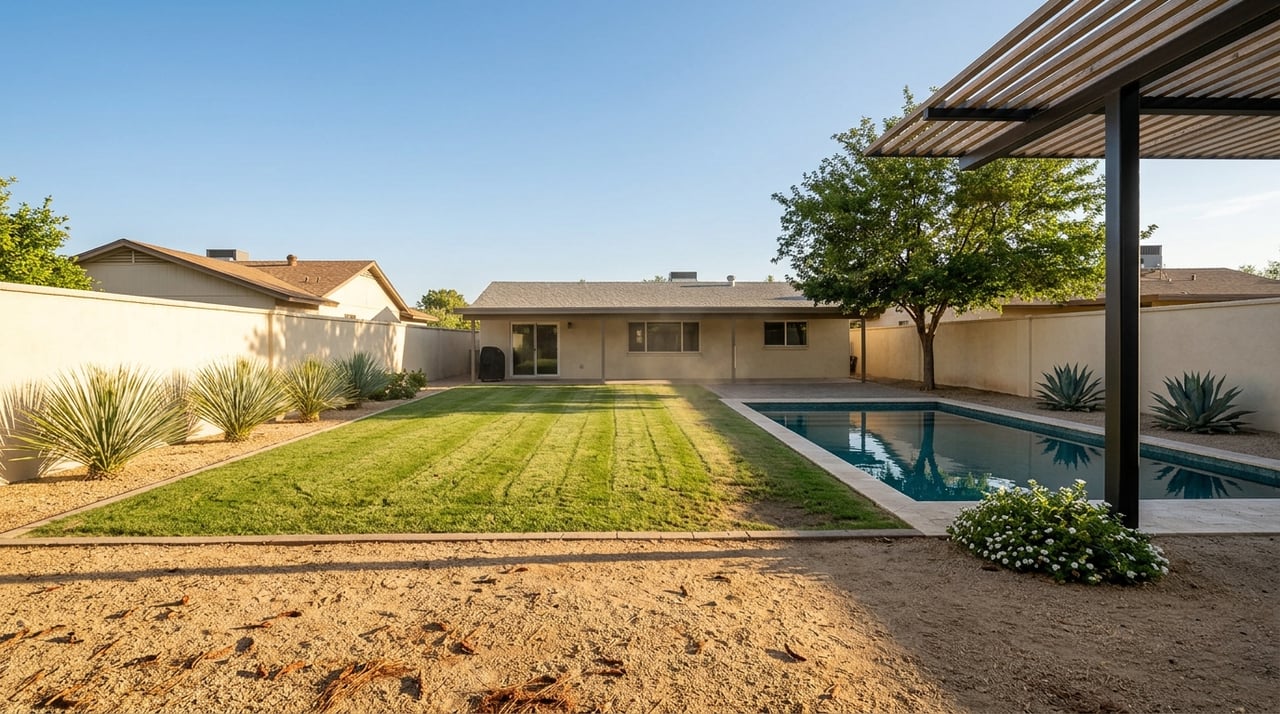
Two ranch homes sit on the same block in Arcadia Lite, built the same year, same square footage under roof, same asking price bracket. One owner can legally add a 1,000-square-foot guest house in the backyard. The neighbor two doors down, whose lot happens to run about 700 square feet larger, may have a slightly higher ceiling if that extra area puts the parcel above 10,000 square feet. The plat map helps show whether it does.
That difference reflects a Phoenix zoning measure: net lot area, measured against 10,000 square feet. As of August 2026, the lot-size limit helps determine the maximum ADU size allowed, alongside the limit based on the main home's floor area.
What Actually Changed, and Why It Matters Now
In 2024, Arizona's House Bill 2720 required Phoenix and every city over 75,000 residents to permit accessory dwelling units on single-family lots as a matter of right, effective January 1, 2025. No special use permit, no public hearing, no case-by-case approval. House Bill 2928, signed in May 2025, extended nearly identical protections to Arizona's counties, with a compliance deadline of January 1, 2026, a date that has already passed as of this writing. Together, the two bills removed the parts of the process that used to depend on a planning commission's mood: owner-occupancy requirements disappeared statewide, and cities lost the ability to demand extra parking for an ADU.
What the state law does not do is hand every city the same size limit. That decision stayed with Phoenix, and Phoenix's answer is where Arcadia's real fault line runs.
The Numbers That Set the ADU Size Limit
Phoenix's ADU standards allow up to two accessory dwelling units on a single-family lot, each sized at no more than 75 percent of the main home's gross floor area. That percentage gets capped a second time by an absolute ceiling tied to lot size. On a net lot of 10,000 square feet or less, the ceiling is a flat 1,000 square feet. Cross above 10,000 square feet, and the ceiling becomes the lesser of 3,000 square feet or 10 percent of the lot.
Run the math on a 2,200-square-foot ranch. On a 6,500-square-foot Arcadia Lite lot, 75 percent of the house would allow 1,650 square feet of ADU, but the lot-size cap of 1,000 square feet governs instead. The homeowner is stuck at 1,000 square feet regardless of how generous the main house is.
Move a few blocks east into Arcadia Proper, where quarter-acre and larger parcels are common, and the same house on an 11,000-square-foot lot faces a different math: 10 percent of 11,000 is 1,100 square feet, still under the 3,000-square-foot cap, so 1,100 becomes the ceiling. Add lot area from there and the number keeps climbing, all the way to the 3,000-square-foot maximum on Arcadia's largest parcels.
The difference between those two owners comes from net lot area, a figure available in county records. The main home's floor area also limits ADU size.
Why This Line Runs Through One Neighborhood, Not Between Two
Arcadia's identity has always split between Arcadia Proper, with its larger citrus-grove-era lots, and Arcadia Lite, with its smaller mid-century parcels closer to 44th Street. What is different about the 10,000-square-foot ADU threshold is that it does not describe the difference between two neighborhoods. It sits inside one, well-known one. A buyer comparing two homes both marketed as Arcadia listings may encounter different ADU size limits because the limits depend on net lot area and the main home's floor area.
The Second Line, the One That Follows the City
Arcadia also straddles an actual jurisdictional boundary between Phoenix and Scottsdale, a line separate from the Scottsdale Unified School District boundary that residents are already used to checking for enrollment purposes. Two homes a few blocks apart, both understood locally as Arcadia, can fall under different building departments entirely.
That distinction has a real dollar figure attached to it for anyone building a casita. Fenn Rogers says Scottsdale requires separately metered electric and gas service for an ADU. Budgeting $8,000 to $15,000 for a new meter, panel, and trenching is a cost that shows up on the Scottsdale side of that line. Anyone pricing a project should confirm which department actually holds permitting authority over the specific parcel before assuming a cost estimate from a neighbor's project down the street applies.
What the Two Tiers Actually Cost
Phoenix-metro construction costs and lot-size tiers combine into a rough picture of what a casita project looks like on each side of the 10,000-square-foot line. Site conditions, finish level, and utility access will move any individual number, but the shape holds.
| Lot Size (net) | Legal ADU Ceiling | Typical Construction Cost | Estimated Appraised Value Added |
|---|---|---|---|
| Up to 10,000 sq ft | 1,000 sq ft | $200,000 to $250,000 (at roughly $200 to $250 per sq ft) | Roughly $40,000 to $87,500 |
| Over 10,000 sq ft | Lesser of 3,000 sq ft or 10% of lot | $300,000 to $350,000 or more for a larger detached build | Roughly $60,000 to $122,500 or more |
| Garage conversion, either tier | $60,000 to $140,000 (at roughly $100 to $175 per sq ft) | Similar percentage lift on a smaller base cost |
The value-added figures come from cost guides specific to the Arcadia submarket, which put a well-built ADU's appraised value contribution at roughly 20 to 35 percent of its construction cost, on top of whatever rental income the unit produces. In a market where ADU-equipped properties remain uncommon, that premium can run higher.
The Casita That's Already in the Backyard
Current Arcadia and Arcadia Lite listings already show detached structures ranging from a 205-square-foot multifunction guest casita to a 400-square-foot mid-century casita, a 600-square-foot unit with a full kitchen, and an 858-square-foot detached guest house. Some of these were built and permitted properly. Others, particularly on older Arcadia Lite properties, were added before the current ordinance existed and were never brought through the city's process as a legal ADU.
That distinction matters at the appraisal desk. Anyone evaluating a home with an existing guest house or casita should ask for the permit record before assuming that square footage will carry through into a purchase appraisal. The Maricopa County Assessor treats a completed, newly legalized structure as an improvement, which typically means a reassessment follows.
Checking Your Own Number
A few minutes of homework before falling for a casita-ready listing description can save months of redesign later.
- Pull the parcel's net lot square footage from the Maricopa County Assessor's parcel viewer, not from the marketing flyer.
- Confirm which city, Phoenix or Scottsdale, actually holds permitting jurisdiction for the specific address.
- Check the CC&Rs if the property falls in one of Arcadia's few HOA-governed pockets. Much of Arcadia carries no HOA at all, but the Design and Remodeling Team notes that an HOA can still restrict or forbid an ADU even where city zoning allows it.
- Ask for permit history on any existing structure marketed as a casita or guest house.
- Run the ceiling math yourself: 75 percent of the main home's square footage against the lot-size cap, then use whichever number is smaller.
What This Changes
The story getting told about Arizona's new casita law is a story about red tape coming down statewide. The more useful story for anyone actually comparing Arcadia properties this year is smaller and more specific. A property's lot size helps determine the maximum ADU size. That factor can affect purchase calculations alongside the home's living area.
A Few Questions Worth Settling Early
Does Phoenix's new ADU law let me rent an Arcadia casita short-term? Confirm current rules for the specific address before planning a purchase or renovation around short-term income.
Will building a casita raise my property taxes? Likely, yes. The Maricopa County Assessor factors completed improvements into assessed value, so a new or newly legalized ADU will typically show up in the next reassessment.
What should I check about my HOA if Phoenix allows ADUs by right? If the property carries an HOA, review its documents before relying on what city zoning permits.
Casita potential is one more variable that belongs in a pricing conversation from the start, not something to discover after closing. If you're weighing an Arcadia purchase or wondering what your current lot could support, The Pontikas Team can walk through your specific parcel and put a real number behind it. Get a Free Home Valuation to start the conversation.
This article is general information, not legal, tax or financial advice. Consult a qualified professional about your situation.