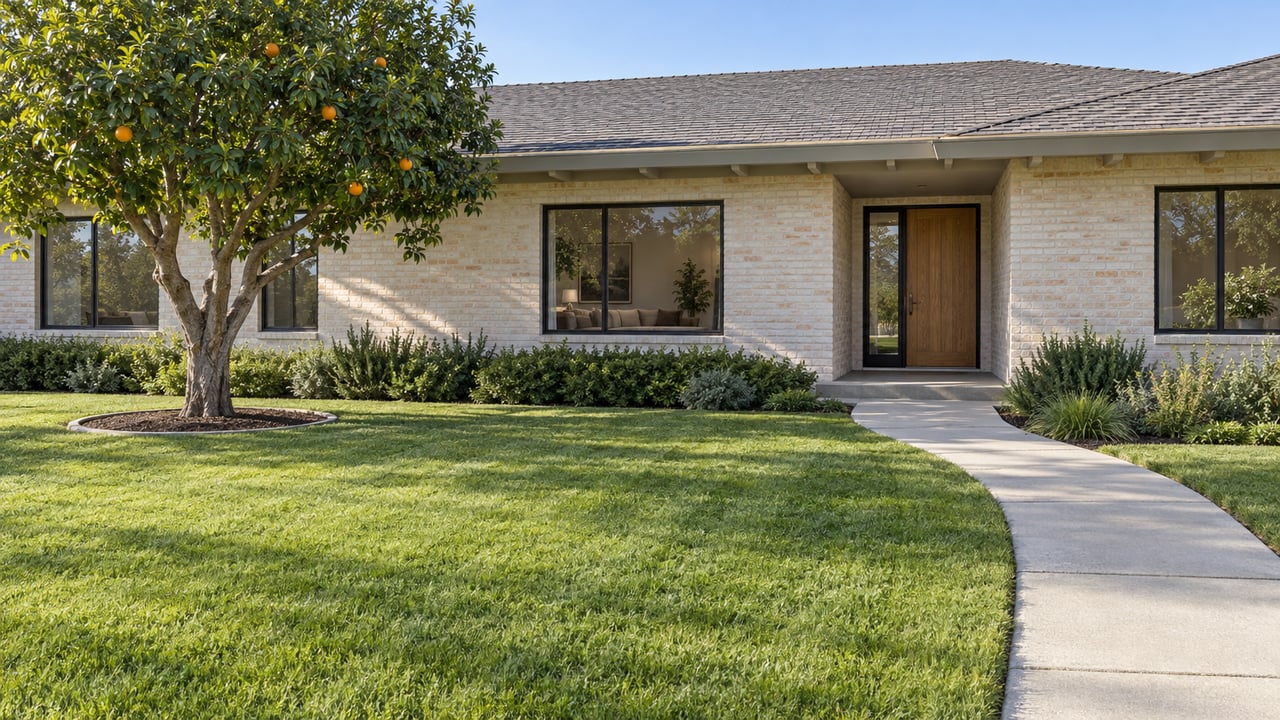
Two separate water systems flood Arcadia's lawns and citrus. One is Salt River Project, which sends canal water from the Arizona Canal through laterals to neighborhood gates. The other is Arcadia Water Company, a member-only nonprofit incorporated in 1919. It pumps from wells it owns, through its own pumping plant and reservoir. October through February brings a lot of irrigation news: a dry-up, an annual bill, and the yearly argument over whether to overseed with rye. Nearly all of that news is SRP news. On some Arcadia streets it describes a system that doesn't reach the gate.
Why a Canal Neighborhood Ended Up With Wells
The split dates back to when Arcadia was groves. A history piece from Arcadia News, republished by the Arcadia Camelback Mountain Neighborhood Association, explains that the Arizona Canal was finished in 1885 and left the land north of it "high and dry." Developer Josiah Harbert came in 1897 to reclaim that land for farming. The same account follows the Burgess Lateral back to a diversion ditch near Arizona Falls at 56th Street and Indian School Road. The ditch appears as "Lateral 4½" in an 1897 subdivision record, and a 1903 Bureau of Reclamation survey map gives it the Burgess name. The lateral ran roughly 4,500 feet through Arcadia. It was lined with eucalyptus planted as windbreaks for the citrus acreage to the east. Arizona Falls is still there on the Arizona Canal between 56th and 58th streets, at G.R. Herberger Park.
Canal water didn't cover all of it, and that gap is how the second system began. The Arcadia Camelback Mountain Neighborhood Association's July 2022 newsletter put it this way:
"In 1919, the Arcadia Water Company was incorporated specifically to provide the necessary water to feed the groves, allowing them to flourish, and since then the company has dug and maintained the local wells, pumped the water through the complex, aging systems of pipes, providing flood irrigation to the properties."
The groves were replaced by houses, but both systems stayed. Their calendars, owners, and contacts are still different today.
What Each System Actually Owns
The two systems split responsibility the same way. Neither one maintains the pipes and ditches inside your subdivision. What differs is the source of the water.
| SRP flood irrigation | Arcadia Water Company | |
|---|---|---|
| Water source | Canal water delivered through the SRP canal network to a neighborhood gate | Company-owned wells, pumping plant and reservoir |
| Who runs the main system | SRP; a zanjero opens the delivery gate | AWC; an Operations Manager and Irrigation Coordinator, with a company zanjero for irrigation emergencies |
| Beyond the main system | Neighborhood or homeowner-owned ditches, channels or pipelines, maintained by homeowners | Sub-distribution systems owned and maintained by members or their HOA |
| Governance | SRP Board of Governors sets charges | An elected 11-person board; annual meeting on the third Tuesday of April |
| Where schedules live | SRP My Account or the SRP Water app | An address-by-address PDF on the AWC website |
AWC's water rights are attached to land inside the Arcadia Water district. They depend on a $100 membership fee plus any charges for water, delivery service or repairs. The company doesn't publish a boundary map or a list of the subdivisions it serves. A neighbor two blocks away can be on the other system.
The SRP Calendar From Now Through February
If your gate is SRP's, the next five months are well documented. The residential cycle shifted this month from about every 14 days to about every 28 days, and it stays there through March. Here are the remaining dates in order:
- Mid-November 2026. SRP issues annual irrigation bills for the coming year.
- Nov. 20 to Dec. 24, 2026. Southside canal dry-ups.
- Dec. 6, 2026. First-payment due date printed on SRP's 2027 residential charge schedule.
- Jan. 3 to Feb. 7, 2027. Northside canal dry-ups.
The 2027 charges are slightly higher than the 2026 rates. The SRP Board of Governors approved the 2027 schedule in March 2026. According to SRP's 2027 residential water charges summary, the annual delivery fee per active account rises from $93.87 to $97.34. The per-acre component goes from $0.45 to $0.47, and the basic stored-and-developed charge goes from $53.52 to $56.16 per acre. For a typical Arcadia lot, the flat delivery fee is the part that changes most.
The Northside dry-up window affects Arcadia most, because the Arizona Canal runs north of the Salt River. SRP's dry-up schedule page gives systemwide dates and says the work rotates on a 10-year schedule, but it doesn't say which reaches are scheduled for early 2027. Last winter's project came very close to Arcadia. SRP's January 2026 release described about eight miles of the Arizona Canal drained from Jan. 8 to Feb. 7, with signs posted from Mesa Drive and Camelback Road west to 68th Street and Indian School Road. It noted that "some of SRP's northside irrigation customers will not receive water from the canals during the dry-up." That project focused on damage from the late-2025 storms. It describes last year's work and doesn't tell you where crews will be in January. SRP Water Transmission takes questions at (602) 236-4956.
Where the Arcadia Water Company Calendar Lives
AWC's calendar is harder to find. Its irrigation schedule page links to one downloadable PDF that lists delivery windows by address. The current file runs through this week, with deliveries scheduled Oct. 12 through Oct. 15, 2026.
The website doesn't state the current seasonal rhythm. Older notices show how AWC has run things in the past. A 2017 post set the summer period at 14-day intervals from February 27 to October 20. A winter notice from that September started 28-day intervals on October 23 and said the slower season was used for repairs and tree painting. In 2018, AWC asked customers to cancel by the Wednesday before their scheduled irrigation. It warned that late cancellations might not stop delivery and that reserved water would be billed. These are past practices and may not match current rules. The office is reachable at [email protected].
Nothing AWC has published mentions SRP's dry-up. Because its water comes from its own wells and reservoir, it's reasonable to think the January canal outage wouldn't stop its deliveries. AWC hasn't confirmed this, though. Its own updates focus on the century-old pipe network it maintains. In July 2020, AWC reported that one of its two main distribution lines under Camelback Road broke over the Fourth of July weekend, and it posted repair updates through late July.
The Rye Question Runs Into Both Clocks
The two calendars matter most for the overseeding decision, and timing makes it urgent. University of Arizona Cooperative Extension's turfgrass guide sets the Phoenix winter-grass seeding window at Oct. 10 to Nov. 10. It says germination and establishment take several waterings a day. A flood turn every 28 days doesn't supply that. On either system, new rye depends on sprinklers or hand watering between turns.
SRP's October 2026 customer newsletter recommends skipping overseeding this year. It estimates winter ryegrass needs more than 8,000 gallons of water per 1,000 square feet. Dormant Bermuda, by comparison, needs water about once a month from November through February, and less if winter rain comes. The Extension guide adds that Bermuda left unseeded tends to green up earlier in spring because it isn't competing with rye.
There's a supply reason too. In a July 2026 record from the Arizona Department of Water Resources, SRP's reservoir storage stood at about 1.13 million acre-feet, or 49% of capacity, as of July 13, with Roosevelt Lake at 38%. After two very dry winters, SRP raised its planned 2026 groundwater pumping to 250,000 acre-feet and plans 275,000 acre-feet for 2027. None of the reviewed sources describes a cut to residential flood-irrigation allocations. They do show more of the system's water coming from underground, which is where Arcadia Water Company has always drawn from.
AWC customers who do overseed have had one more step. A 2015 notice asked anyone planning to overseed to tell the office by the Wednesday before their water week. The office can say whether that still applies.
Finding Your Gate
The quickest way to tell which system serves your property is the paperwork. An SRP irrigation account shows up in SRP My Account and the SRP Water app, along with your neighborhood's order deadlines. AWC members are listed by address in the company's schedule PDF. On SRP's side, neighborhood volunteers called Key Homeowners help coordinate the shared system past the gate, and on AWC's side, members or their HOA own the subdivision lines.
Citrus is the other half of the winter yard, and there are local resources for it. Urban Farm Nursery's 2026 fruit-tree series has live classes on Oct. 13, 19 and 26, including a session on planting, watering and fertilizing. Closer to home, Berridge Nurseries is on Camelback Road at 46th Street. Its winter-rose-care class on Dec. 5 lands right before SRP's Northside dry-up.
Which irrigation system serves a property is one of the details that comes up during a sale, through water-company membership, subdivision ditches, and who maintains what beyond the gate. If you're thinking ahead and want to know how your lot, irrigation, and mature citrus show up in its value, The Pontikas Team can give you a clear, current answer. Request a free home valuation and we'll go over it with you.